

Get Instant Access of 100% REAL Databricks-Certified-Data-Engineer-Associate DUMP Pass Your Exam Easily
Databricks-Certified-Data-Engineer-Associate Free Exam Questions with Quality Guaranteed
Databricks-Certified-Data-Engineer-Associate exam is a comprehensive exam that tests the individual's knowledge of Databricks and its various features. Databricks-Certified-Data-Engineer-Associate exam includes multiple-choice questions that require the individual to select the best answer from a list of options. Databricks-Certified-Data-Engineer-Associate exam also includes hands-on tasks that require the individual to demonstrate their ability to perform specific tasks using Databricks.
The GAQM Databricks-Certified-Data-Engineer-Associate (Databricks Certified Data Engineer Associate) exam is a certification program designed for individuals who wish to demonstrate their expertise in designing and implementing big data solutions using Databricks. Databricks-Certified-Data-Engineer-Associate exam is intended for data engineers, data analysts, and big data architects who want to validate their skills in building and managing large-scale data processing systems using Databricks.
NEW QUESTION # 30
Which of the following SQL keywords can be used to convert a table from a long format to a wide format?
- A. CONVERT
- B. SUM
- C. WHERE
- D. TRANSFORM
- E. PIVOT
Answer: E
Explanation:
The SQL keyword that can be used to convert a table from a long format to a wide format is PIVOT. The PIVOT clause is used to rotate the rows of a table into columns of a new table1. The PIVOT clause can aggregate the values of a column based on the distinct values of another column, and use those values as the column names of the new table1. The PIVOT clause can be useful for transforming data from a long format, where each row represents an observation with multiple attributes, to a wide format, where each row represents an observation with a single attribute and multiple values2. For example, the PIVOT clause can be used to convert a table that contains the sales of different products by different regions into a table that contains the sales of each product by each region as separate columns1.
The other options are not suitable for converting a table from a long format to a wide format. CONVERT is a function that can be used to change the data type of an expression3. WHERE is a clause that can be used to filter the rows of a table based on a condition4. TRANSFORM is a keyword that can be used to apply a user-defined function to a group of rows in a table5. SUM is a function that can be used to calculate the total of a numeric column.
References:
* 1: PIVOT | Databricks on AWS
* 2: Reshaping Data - Long vs Wide Format | Databricks on AWS
* 3: CONVERT | Databricks on AWS
* 4: WHERE | Databricks on AWS
* 5: TRANSFORM | Databricks on AWS
* : [SUM | Databricks on AWS]
NEW QUESTION # 31
A data engineer has been using a Databricks SQL dashboard to monitor the cleanliness of the input data to an ELT job. The ELT job has its Databricks SQL query that returns the number of input records containing unexpected NULL values. The data engineer wants their entire team to be notified via a messaging webhook whenever this value reaches 100.
Which of the following approaches can the data engineer use to notify their entire team via a messaging webhook whenever the number of NULL values reaches 100?
- A. They can set up an Alert with a new webhook alert destination.
- B. They can set up an Alert with a custom template.
- C. They can set up an Alert with a new email alert destination.
- D. They can set up an Alert with one-time notifications.
- E. They can set up an Alert without notifications.
Answer: A
Explanation:
A webhook alert destination is a way to send notifications to external applications or services via HTTP requests. A data engineer can use a webhook alert destination to notify their entire team via a messaging webhook, such as Slack or Microsoft Teams, whenever the number of NULL values in the input data reaches
100. To set up a webhook alert destination, the data engineer needs to do the following steps:
* In the Databricks SQL workspace, navigate to the Settings gear icon and select SQL Admin Console.
* Click Alert Destinations and click Add New Alert Destination.
* Select Webhook and enter the webhook URL and the optional custom template for the notification message.
* Click Create to save the webhook alert destination.
* In the Databricks SQL editor, create or open the query that returns the number of input records containing unexpected NULL values.
* Click the Create Alert icon above the editor window and configure the alert criteria, such as the value column, the condition, and the threshold.
* In the Notification section, select the webhook alert destination that was created earlier and click Create Alert. References: What are Databricks SQL alerts?, Monitor alerts, Monitoring Your Business with
* Alerts, Using Automation Runbook Webhooks To Alert on Databricks Status Updates.
NEW QUESTION # 32
A new data engineering team team has been assigned to an ELT project. The new data engineering team will need full privileges on the table sales to fully manage the project.
Which of the following commands can be used to grant full permissions on the database to the new data engineering team?
- A. GRANT USAGE ON TABLE sales TO team;
- B. GRANT SELECT ON TABLE sales TO team;
- C. GRANT SELECT CREATE MODIFY ON TABLE sales TO team;
- D. GRANT ALL PRIVILEGES ON TABLE sales TO team;
- E. GRANT ALL PRIVILEGES ON TABLE team TO sales;
Answer: D
Explanation:
To grant full permissions on a table to a user or a group, you can use the GRANT ALL PRIVILEGES ON TABLE statement. This statement will grant all the possible privileges on the table, such as SELECT, CREATE, MODIFY, DROP, ALTER, etc. Option A is the only code block that follows this syntax correctly. Option B is incorrect, as it does not grant all the possible privileges on the table, but only a subset of them. Option C is incorrect, as it only grants the SELECT privilege on the table, which is not enough to fully manage the project. Option D is incorrect, as it grants the USAGE privilege on the table, which is not a valid privilege for tables. Option E is incorrect, as it grants all the privileges on the table team to the user or group sales, which is the opposite of what the question asks. References: Grant privileges on a table using SQL | Databricks on AWS, Grant privileges on a table using SQL - Azure Databricks, SQL Privileges - Databricks
NEW QUESTION # 33
A data engineer needs to determine whether to use the built-in Databricks Notebooks versioning or version their project using Databricks Repos.
Which of the following is an advantage of using Databricks Repos over the Databricks Notebooks versioning?
- A. Databricks Repos allows users to revert to previous versions of a notebook
- B. Databricks Repos is wholly housed within the Databricks Lakehouse Platform
- C. Databricks Repos supports the use of multiple branches
- D. Databricks Repos automatically saves development progress
- E. Databricks Repos provides the ability to comment on specific changes
Answer: C
Explanation:
Explanation
An advantage of using Databricks Repos over the built-in Databricks Notebooks versioning is the ability to work with multiple branches. Branching is a fundamental feature ofversion control systems like Git, which Databricks Repos is built upon. It allows you to create separate branches for different tasks, features, or experiments within your project. This separation helps in parallel development and experimentation without affecting the main branch or the work of other team members. Branching provides a more organized and collaborative development environment, making it easier to merge changes and manage different development efforts. While Databricks Notebooks versioning also allows you to track versions of notebooks, it may not provide the same level of flexibility and collaboration as branching in Databricks Repos.
NEW QUESTION # 34
A data engineer only wants to execute the final block of a Python program if the Python variable day_of_week is equal to 1 and the Python variable review_period is True.
Which of the following control flow statements should the data engineer use to begin this conditionally executed code block?
- A. if day_of_week = 1 and review_period:
- B. if day_of_week = 1 and review_period = "True":
- C. if day_of_week == 1 and review_period:
- D. if day_of_week == 1 and review_period == "True":
- E. if day_of_week = 1 & review_period: = "True":
Answer: D
NEW QUESTION # 35
A data engineer needs to apply custom logic to identify employees with more than 5 years of experience in array column employees in table stores. The custom logic should create a new column exp_employees that is an array of all of the employees with more than 5 years of experience for each row. In order to apply this custom logic at scale, the data engineer wants to use the FILTER higher-order function.
Which of the following code blocks successfully completes this task?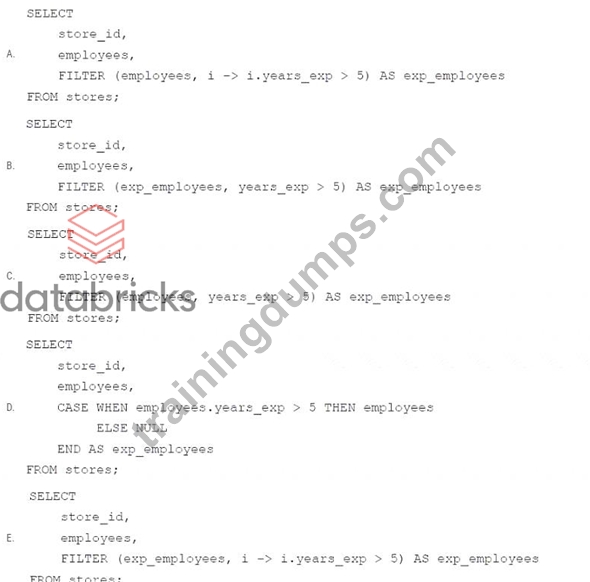
- A. Option B
- B. Option D
- C. Option C
- D. Option E
- E. Option A
Answer: E
NEW QUESTION # 36
A data engineer needs to create a table in Databricks using data from their organization's existing SQLite database.
They run the following command: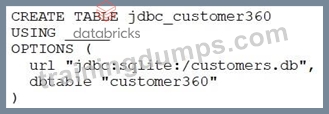
Which of the following lines of code fills in the above blank to successfully complete the task?
- A. autoloader
- B. DELTA
- C. org.apache.spark.sql.sqlite
- D. org.apache.spark.sql.jdbc
- E. sqlite
Answer: C
NEW QUESTION # 37
A new data engineering team has been assigned to work on a project. The team will need access to database customers in order to see what tables already exist. The team has its own group team.
Which of the following commands can be used to grant the necessary permission on the entire database to the new team?
- A. GRANT CREATE ON DATABASE customers TO team;
- B. GRANT VIEW ON CATALOG customers TO team;
- C. GRANT USAGE ON DATABASE customers TO team;
- D. GRANT USAGE ON CATALOG team TO customers;
Answer: C
NEW QUESTION # 38
Which of the following benefits is provided by the array functions from Spark SQL?
- A. An ability to work with data in a variety of types at once
- B. An ability to work with data within certain partitions and windows
- C. An ability to work with an array of tables for procedural automation
- D. An ability to work with complex, nested data ingested from JSON files
- E. An ability to work with time-related data in specified intervals
Answer: B
NEW QUESTION # 39
Which of the following tools is used by Auto Loader process data incrementally?
- A. Unity Catalog
- B. Checkpointing
- C. Spark Structured Streaming
- D. Databricks SQL
- E. Data Explorer
Answer: C
NEW QUESTION # 40
A data engineer only wants to execute the final block of a Python program if the Python variable day_of_week is equal to 1 and the Python variable review_period is True.
Which of the following control flow statements should the data engineer use to begin this conditionally executed code block?
- A. if day_of_week == 1 and review_period == "True":
- B. if day_of_week = 1 and review_period:
- C. if day_of_week = 1 and review_period = "True":
- D. if day_of_week == 1 and review_period:
- E. if day_of_week = 1 & review_period: = "True":
Answer: D
Explanation:
In Python, the == operator is used to compare the values of two variables, while the = operator is used to assign a value to a variable. Therefore, option A and E are incorrect, as they use the = operator for comparison.
Option B and C are also incorrect, as they compare the review_period variable to a string value "True", which is different from the boolean value True. Option D is the correct answer, as it uses the == operator to compare the day_of_week variable to the integer value 1, and the and operator to check if both conditions are true. If both conditions are true, then the final block of the Python program will be executed. References: [Python Operators], [Python If ... Else]
NEW QUESTION # 41
A data analyst has created a Delta table sales that is used by the entire data analysis team. They want help from the data engineering team to implement a series of tests to ensure the data is clean. However, the data engineering team uses Python for its tests rather than SQL.
Which of the following commands could the data engineering team use to access sales in PySpark?
- A. spark.delta.table("sales")
- B. There is no way to share data between PySpark and SQL.
- C. spark.table("sales")
- D. SELECT * FROM sales
- E. spark.sql("sales")
Answer: C
Explanation:
Explanation
https://spark.apache.org/docs/3.2.1/api/python/reference/api/pyspark.sql.SparkSession.table.html
NEW QUESTION # 42
A data engineer wants to create a new table containing the names of customers that live in France.
They have written the following command: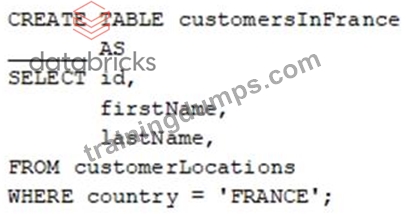
A senior data engineer mentions that it is organization policy to include a table property indicating that the new table includes personally identifiable information (PII).
Which of the following lines of code fills in the above blank to successfully complete the task?
- A. There is no way to indicate whether a table contains PII.
- B. PII
- C. TBLPROPERTIES PII
- D. COMMENT "Contains PII"
- E. "COMMENT PII"
Answer: D
Explanation:
Explanation
Ref:https://www.databricks.com/discover/pages/data-quality-management
CREATE TABLE my_table (id INT COMMENT 'Unique Identification Number', name STRING COMMENT 'PII', age INT COMMENT 'PII') TBLPROPERTIES ('contains_pii'=True) COMMENT 'Contains PII';
NEW QUESTION # 43
A data engineer needs to apply custom logic to identify employees with more than 5 years of experience in array column employees in table stores. The custom logic should create a new column exp_employees that is an array of all of the employees with more than 5 years of experience for each row. In order to apply this custom logic at scale, the data engineer wants to use the FILTER higher-order function.
Which of the following code blocks successfully completes this task?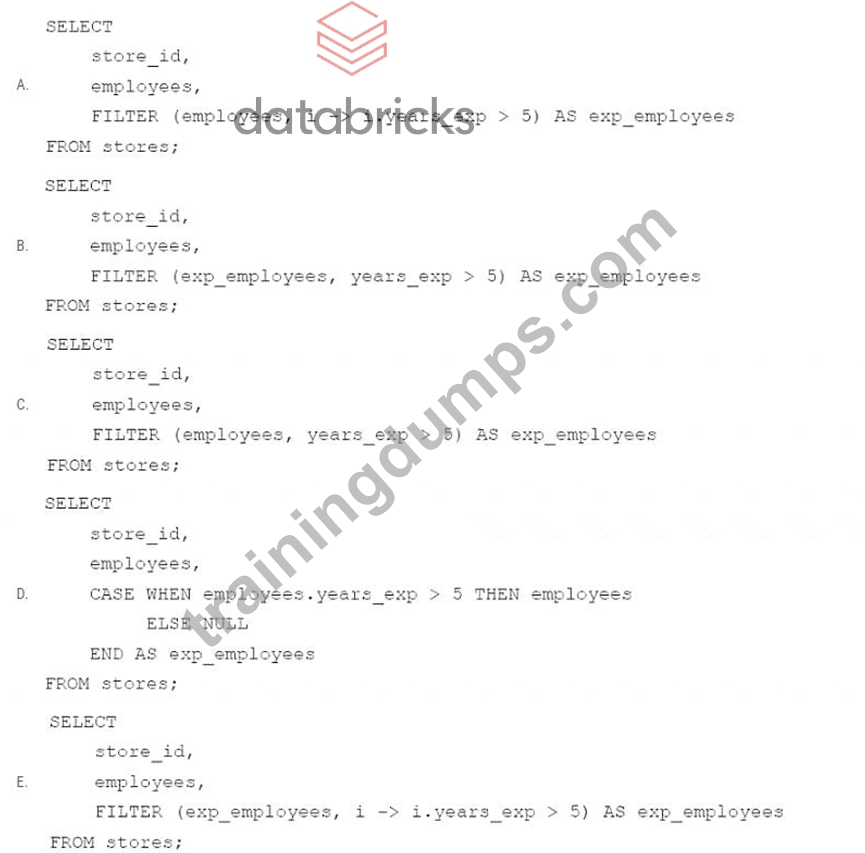
- A. Option B
- B. Option D
- C. Option C
- D. Option E
- E. Option A
Answer: E
Explanation:
Option A is the correct answer because it uses the FILTER higher-order function correctly to filter out employees with more than 5 years of experience from the array column "employees". It applies a lambda function i -> i.years_exp > 5 that checks if the years of experience of each employee in the array is greater than 5. If this condition is met, the employee is included in the new array column "exp_employees".
References: The use of higher-order functions like FILTER can be referenced from Databricks documentation on Higher-Order Functions.
NEW QUESTION # 44
A data engineer is attempting to drop a Spark SQL table my_table. The data engineer wants to delete all table metadata and data.
They run the following command:
DROP TABLE IF EXISTS my_table
While the object no longer appears when they run SHOW TABLES, the data files still exist.
Which of the following describes why the data files still exist and the metadata files were deleted?
- A. The table did not have a location
- B. The table's data was smaller than 10 GB
- C. The table was managed
- D. The table's data was larger than 10 GB
- E. The table was external
Answer: E
Explanation:
Explanation
The reason why the data files still exist while the metadata files were deleted is because the table was external.
When a table is external in Spark SQL (or in other database systems), it means that the table metadata (such as schema information and table structure) is managed externally, and Spark SQL assumes that the data is managed and maintained outside of the system. Therefore, when you execute a DROP TABLE statement for an external table, it removes only the table metadata from the catalog, leaving the data files intact. On the other hand, for managed tables (option E), Spark SQL manages both the metadata and the data files. When you drop a managed table, it deletes both the metadata and the associated data files, resulting in a complete removal of the table.
NEW QUESTION # 45
A dataset has been defined using Delta Live Tables and includes an expectations clause:
CONSTRAINT valid_timestamp EXPECT (timestamp > '2020-01-01') ON VIOLATION FAIL UPDATE What is the expected behavior when a batch of data containing data that violates these constraints is processed?
- A. Records that violate the expectation are dropped from the target dataset and recorded as invalid in the event log.
- B. Records that violate the expectation are dropped from the target dataset and loaded into a quarantine table.
- C. Records that violate the expectation are added to the target dataset and recorded as invalid in the event log.
- D. Records that violate the expectation cause the job to fail.
- E. Records that violate the expectation are added to the target dataset and flagged as invalid in a field added to the target dataset.
Answer: D
Explanation:
Explanation
https://docs.databricks.com/en/delta-live-tables/expectations.html
Action
Result
warn (default)
Invalid records are written to the target; failure is reported as a metric for the dataset.
drop
Invalid records are dropped before data is written to the target; failure is reported as a metrics for the dataset.
fail
Invalid records prevent the update from succeeding. Manual intervention is required before re-processing.
NEW QUESTION # 46
Which of the following must be specified when creating a new Delta Live Tables pipeline?
- A. At least one notebook library to be executed
- B. A key-value pair configuration
- C. A location of a target database for the written data
- D. A path to cloud storage location for the written data
- E. The preferred DBU/hour cost
Answer: A
Explanation:
Option E is the correct answer because it is the only mandatory requirement when creating a new Delta Live Tables pipeline. A pipeline is a data processing workflow that contains materialized views and streaming tables declared in Python or SQL source files. Delta Live Tables infers the dependencies between these tables and ensures updates occur in the correct order. To create a pipeline, you need to specify at least one notebook library to be executed, which contains the Delta Live Tables syntax. You can also specify multiple libraries of different languages within your pipeline. The other options are optional or not applicable for creating a pipeline. Option A is not required, but you can optionally provide a key-value pair configuration to customize the pipeline settings, such as the storage location, the target schema, the notifications, and the pipeline mode.
Option B is not applicable, as the DBU/hour cost is determined by the cluster configuration, not the pipeline creation. Option C is not required, but you can optionally specify a storage location for the output data from the pipeline. If you leave it empty, the system uses a default location. Option D is not required, but you can optionally specify a location of a target database for the written data, either in the Hive metastore or the Unity Catalog.
References: Tutorial: Run your first Delta Live Tables pipeline, What is Delta Live Tables?, Create a pipeline, Pipeline configuration.
NEW QUESTION # 47
Which of the following describes when to use the CREATE STREAMING LIVE TABLE (formerly CREATE INCREMENTAL LIVE TABLE) syntax over the CREATE LIVE TABLE syntax when creating Delta Live Tables (DLT) tables using SQL?
- A. CREATE STREAMING LIVE TABLE should be used when the previous step in the DLT pipeline is static.
- B. CREATE STREAMING LIVE TABLE should be used when the subsequent step in the DLT pipeline is static.
- C. CREATE STREAMING LIVE TABLE is redundant for DLT and it does not need to be used.
- D. CREATE STREAMING LIVE TABLE should be used when data needs to be processed incrementally.
- E. CREATE STREAMING LIVE TABLE should be used when data needs to be processed through complicated aggregations.
Answer: D
NEW QUESTION # 48
......
The GAQM Databricks-Certified-Data-Engineer-Associate (Databricks Certified Data Engineer Associate) certification exam is designed for professionals who want to demonstrate their expertise in building and maintaining data pipelines on the Databricks platform. Databricks-Certified-Data-Engineer-Associate exam validates the skills and knowledge required to design, build, and maintain data pipelines on Databricks, and is a recognition of the candidate's ability to work with big data technologies and tools.
Databricks-Certified-Data-Engineer-Associate Free Exam Files Downloaded Instantly: https://pdfvce.trainingdumps.com/Databricks-Certified-Data-Engineer-Associate-valid-vce-dumps.html
