

Jun 26, 2024 PASS Snowflake ARA-C01 EXAM WITH UPDATED DUMPS
ARA-C01 Questions PDF [2024] Use Valid New dump to Clear Exam
Snowflake ARA-C01: SnowPro Advanced Architect Certification Exam is an essential step for professionals looking to advance their careers in the field of data warehousing and cloud computing. It is designed to test an individual's knowledge and expertise in advanced Snowflake architecture and is a valuable accomplishment that demonstrates an individual's commitment to the platform.
Snowflake ARA-C01 (SnowPro Advanced Architect Certification) Exam is a comprehensive certification program designed to test the advanced expertise of Snowflake architects. Snowflake is a cloud-based data warehousing and analytics platform that provides businesses with a scalable, secure, and cost-effective solution for big data management and analysis. The SnowPro Advanced Architect Certification Exam is aimed at professionals who have a deep understanding of the Snowflake platform and are capable of designing and implementing complex data warehousing and analytics solutions.
NEW QUESTION # 32 
Based on the architecture in the image, how can the data from DB1 be copied into TBL2? (Select TWO).
- A. A white background with black text Description automatically generated

- B. A close-up of a computer code Description automatically generated

- C. A computer code with black text Description automatically generated

- D. A white background with black text Description automatically generated
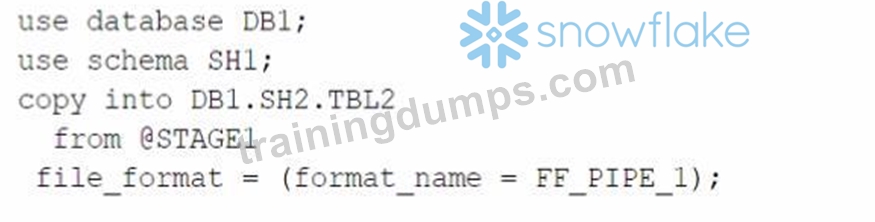
- E. A close-up of a computer code Description automatically generated

Answer: A,E
Explanation:
* The architecture in the image shows a Snowflake data platform with two databases, DB1 and DB2, and two schemas, SH1 and SH2. DB1 contains a table TBL1 and a stage STAGE1. DB2 contains a table TBL2. The image also shows a snippet of code written in SQL language that copies data from STAGE1 to TBL2 using a file format FF PIPE 1.
* To copy data from DB1 to TBL2, there are two possible options among the choices given:
* Option B: Use a named external stage that references STAGE1. This option requires creating an external stage object in DB2.SH2 that points to the same location as STAGE1 in DB1.SH1. The external stage can be created using the CREATE STAGE command with the URL parameter specifying the location of STAGE11. For example:
SQLAI-generated code. Review and use carefully. More info on FAQ.
use database DB2;
use schema SH2;
create stage EXT_STAGE1
url = @DB1.SH1.STAGE1;
* Then, the data can be copied from the external stage to TBL2 using the COPY INTO command with the FROM parameter specifying the external stage name and the FILE FORMAT parameter specifying the file format name2. For example:
SQLAI-generated code. Review and use carefully. More info on FAQ.
copy into TBL2
from @EXT_STAGE1
file format = (format name = DB1.SH1.FF PIPE 1);
* Option E: Use a cross-database query to select data from TBL1 and insert into TBL2. This option requires using the INSERT INTO command with the SELECT clause to query data from TBL1 in DB1.SH1 and insert it into TBL2 in DB2.SH2. The query must use the fully-qualified names of the tables, including the database and schema names3. For example:
SQLAI-generated code. Review and use carefully. More info on FAQ.
use database DB2;
use schema SH2;
insert into TBL2
select * from DB1.SH1.TBL1;
* The other options are not valid because:
* Option A: It uses an invalid syntax for the COPY INTO command. The FROM parameter cannot specify a table name, only a stage name or a file location2.
* Option C: It uses an invalid syntax for the COPY INTO command. The FILE FORMAT parameter cannot specify a stage name, only a file format name or options2.
* Option D: It uses an invalid syntax for the CREATE STAGE command. The URL parameter cannot specify a table name, only a file location1.
References:
* 1: CREATE STAGE | Snowflake Documentation
* 2: COPY INTO table | Snowflake Documentation
* 3: Cross-database Queries | Snowflake Documentation
NEW QUESTION # 33
A company has built a data pipeline using Snowpipe to ingest files from an Amazon S3 bucket. Snowpipe is configured to load data into staging database tables. Then a task runs to load the data from the staging database tables into the reporting database tables.
The company is satisfied with the availability of the data in the reporting database tables, but the reporting tables are not pruning effectively. Currently, a size 4X-Large virtual warehouse is being used to query all of the tables in the reporting database.
What step can be taken to improve the pruning of the reporting tables?
- A. Use an ORDER BY <cluster_key (s) > command to load the reporting tables.
- B. Create larger files for Snowpipe to ingest and ensure the staging frequency does not exceed 1 minute.
- C. Eliminate the use of Snowpipe and load the files into internal stages using PUT commands.
- D. Increase the size of the virtual warehouse to a size 5X-Large.
Answer: A
Explanation:
Effective pruning in Snowflake relies on the organization of data within micro-partitions. By using an ORDER BY clause with clustering keys when loading data into the reporting tables, Snowflake can better organize the data within micro-partitions. This organization allows Snowflake to skip over irrelevant micro-partitions during a query, thus improving query performance and reducing the amount of data scanned12.
References =
*Snowflake Documentation on micro-partitions and data clustering2
*Community article on recognizing unsatisfactory pruning and improving it1
NEW QUESTION # 34
How will you drop a cluster key?
- A. ALTER TABLE <name> REMOVE CLUSTERING KEY
- B. ALTER TABLE <name> DROP CLUSTERING KEY
- C. ALTER TABLE <name> DELETE CLUSTERING KEY
Answer: B
NEW QUESTION # 35
Data is being imported and stored as JSON in a VARIANT column. Query performance was fine, but most recently, poor query performance has been reported.
What could be causing this?
- A. The recent data imports contained fewer fields than usual.
- B. There were variations in string lengths for the JSON values in the recent data imports.
- C. There were JSON nulls in the recent data imports.
- D. The order of the keys in the JSON was changed.
Answer: B
NEW QUESTION # 36
Company A would like to share data in Snowflake with Company B. Company B is not on the same cloud platform as Company A.
What is required to allow data sharing between these two companies?
- A. Create a pipeline to write shared data to a cloud storage location in the target cloud provider.
- B. Company A and Company B must agree to use a single cloud platform: Data sharing is only possible if the companies share the same cloud provider.
- C. Setup data replication to the region and cloud platform where the consumer resides.
- D. Ensure that all views are persisted, as views cannot be shared across cloud platforms.
Answer: C
Explanation:
According to the SnowPro Advanced: Architect documents and learning resources, the requirement to allow data sharing between two companies that are not on the same cloud platform is to set up data replication to the region and cloud platform where the consumer resides. Data replication is a feature of Snowflake that enables copying databases across accounts in different regions and cloud platforms. Data replication allows data providers to securely share data with data consumers across different regions and cloud platforms by creating a replica database in the consumer's account. The replica database is read-only and automatically synchronized with the primary database in the provider's account. Data replication is useful for scenarios where data sharing is not possible or desirable due to latency, compliance, or security reasons1. The other options are incorrect because they are not required or feasible to allow data sharing between two companies that are not on the same cloud platform. Option A is incorrect because creating a pipeline to write shared data to a cloud storage location in the target cloud provider is not a secure or efficient way of sharing data. It would require additional steps to load the data from the cloud storage to the consumer's account, and it would not leverage the benefits of Snowflake's data sharing features. Option B is incorrect because ensuring that all views are persisted is not relevant for data sharing across cloud platforms. Views can be shared across cloud platforms as long as they reference objects in the same database. Persisting views is an option to improve the performance of querying views, but it is not required for data sharing2. Option D is incorrect because Company A and Company B do not need to agree to use a single cloud platform. Data sharing is possible across different cloud platforms using data replication or other methods, such as listings or auto-fulfillment3. Reference: Replicating Databases Across Multiple Accounts | Snowflake Documentation, Persisting Views | Snowflake Documentation, Sharing Data Across Regions and Cloud Platforms | Snowflake Documentation
NEW QUESTION # 37
When loading data into a table that captures the load time in a column with a default value of either CURRENT_TIME () or CURRENT_TIMESTAMP() what will occur?
- A. Any rows loaded using a specific COPY statement will have varying timestamps based on when the rows were created in the source.
- B. All rows loaded using a specific COPY statement will have the same timestamp value.
- C. Any rows loaded using a specific COPY statement will have varying timestamps based on when the rows were read from the source.
- D. All rows loaded using a specific COPY statement will have varying timestamps based on when the rows were inserted.
Answer: B
Explanation:
According to the Snowflake documentation, when loading data into a table that captures the load time in a column with a default value of either CURRENT_TIME () or CURRENT_TIMESTAMP(), the default value is evaluated once per COPY statement, not once per row. Therefore, all rows loaded using a specific COPY statement will have the same timestamp value. This behavior ensures that the timestamp value reflects the time when the data was loaded into the table, not when the data was read from the source or created in the source.
References:
* Snowflake Documentation: Loading Data into Tables with Default Values
* Snowflake Documentation: COPY INTO table
NEW QUESTION # 38
Data is being imported and stored as JSON in a VARIANT column. Query performance was fine, but most recently, poor query performance has been reported.
What could be causing this?
- A. The recent data imports contained fewer fields than usual.
- B. The order of the keys in the JSON was changed.
- C. There were variations in string lengths for the JSON values in the recent data imports.
- D. There were JSON nulls in the recent data imports.
Answer: B,C
Explanation:
Data is being imported and stored as JSON in a VARIANT column. Query performance was fine, but most recently, poor query performance has been reported. This could be caused by the following factors:
The order of the keys in the JSON was changed. Snowflake stores semi-structured data internally in a column-like structure for the most common elements, and the remainder in a leftovers-like column. The order of the keys in the JSON affects how Snowflake determines the common elements and how it optimizes the query performance. If the order of the keys in the JSON was changed, Snowflake might have to re-parse the data and re-organize the internal storage, which could result in slower query performance.
There were variations in string lengths for the JSON values in the recent data imports. Non-native values, such as dates and timestamps, are stored as strings when loaded into a VARIANT column. Operations on these values could be slower and also consume more space than when stored in a relational column with the corresponding data type. If there were variations in string lengths for the JSON values in the recent data imports, Snowflake might have to allocate more space and perform more conversions, which could also result in slower query performance.
The other options are not valid causes for poor query performance:
There were JSON nulls in the recent data imports. Snowflake supports two types of null values in semi-structured data: SQL NULL and JSON null. SQL NULL means the value is missing or unknown, while JSON null means the value is explicitly set to null. Snowflake can distinguish between these two types of null values and handle them accordingly. Having JSON nulls in the recent data imports should not affect the query performance significantly.
The recent data imports contained fewer fields than usual. Snowflake can handle semi-structured data with varying schemas and fields. Having fewer fields than usual in the recent data imports should not affect the query performance significantly, as Snowflake can still optimize the data ingestion and query execution based on the existing fields.
Reference:
Considerations for Semi-structured Data Stored in VARIANT
Snowflake Architect Training
Snowflake query performance on unique element in variant column
Snowflake variant performance
NEW QUESTION # 39
Refer to the exhibit.
Based on the architecture in the image, how can the data from DB1 be copied into TBL2? (Select TWO).
- A.

- B.
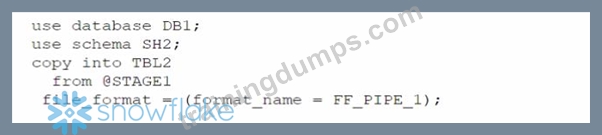
- C.
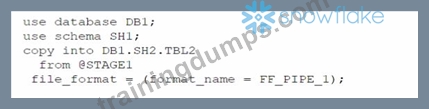
- D.

- E.

Answer: B,D
NEW QUESTION # 40
An Architect has been asked to clone schema STAGING as it looked one week ago, Tuesday June 1st at 8:00 AM, to recover some objects.
The STAGING schema has 50 days of retention.
The Architect runs the following statement:
CREATE SCHEMA STAGING_CLONE CLONE STAGING at (timestamp => '2021-06-01 08:00:00'); The Architect receives the following error: Time travel data is not available for schema STAGING. The requested time is either beyond the allowed time travel period or before the object creation time.
The Architect then checks the schema history and sees the following:
CREATED_ON|NAME|DROPPED_ON
2021-06-02 23:00:00 | STAGING | NULL
2021-05-01 10:00:00 | STAGING | 2021-06-02 23:00:00
How can cloning the STAGING schema be achieved?
- A. Undrop the STAGING schema and then rerun the CLONE statement.
- B. Modify the statement: CREATE SCHEMA STAGING_CLONE CLONE STAGING at (timestamp =>
'2021-05-01 10:00:00'); - C. Rename the STAGING schema and perform an UNDROP to retrieve the previous STAGING schema version, then run the CLONE statement.
- D. Cloning cannot be accomplished because the STAGING schema version was not active during the proposed Time Travel time period.
Answer: C
Explanation:
Explanation
* The error message indicates that the schema STAGING does not have time travel data available for the requested timestamp, because the current version of the schema was created on2021-06-02 23:00:00, which is after the timestamp of 2021-06-01 08:00:00. Therefore, the CLONE statement cannot access the historical data of the schema at that point in time.
* Option A is incorrect, because undropping the STAGING schema will not restore the previous version of the schema that was active on 2021-06-01 08:00:00. Instead, it will create a new version of the schema with the same name and no data or objects.
* Option B is incorrect, because modifying the timestamp to 2021-05-01 10:00:00 will not clone the schema as it looked one week ago, but as it looked when it was first created. This may not reflect the desired state of the schema and its objects.
* Option C is correct, because renaming the STAGING schema and performing an UNDROP to retrieve the previous STAGING schema version will restore the schema that was dropped on 2021-06-02
23:00:00. This schema has time travel data available for the requested timestamp of 2021-06-01
08:00:00, and can be cloned using the CLONE statement.
* Option D is incorrect, because cloning can be accomplished by using the UNDROP command to access the previous version of the schema that was active during the proposed time travel period.
References: : Cloning Considerations : Understanding & Using Time Travel : CREATE <object> ... CLONE
NEW QUESTION # 41
A retail company has over 3000 stores all using the same Point of Sale (POS) system. The company wants to deliver near real-time sales results to category managers. The stores operate in a variety of time zones and exhibit a dynamic range of transactions each minute, with some stores having higher sales volumes than others.
Sales results are provided in a uniform fashion using data engineered fields that will be calculated in a complex data pipeline. Calculations include exceptions, aggregations, and scoring using external functions interfaced to scoring algorithms. The source data for aggregations has over 100M rows.
Every minute, the POS sends all sales transactions files to a cloud storage location with a naming convention that includes store numbers and timestamps to identify the set of transactions contained in the files. The files are typically less than 10MB in size.
How can the near real-time results be provided to the category managers? (Select TWO).
- A. An external scheduler should examine the contents of the cloud storage location and issue SnowSQL commands to process the data at a frequency that matches the real-time analytics needs.
- B. All files should be concatenated before ingestion into Snowflake to avoid micro-ingestion.
- C. A Snowpipe should be created and configured with AUTO_INGEST = true. A stream should be created to process INSERTS into a single target table using the stream metadata to inform the store number and timestamps.
- D. The copy into command with a task scheduled to run every second should be used to achieve the near-real time requirement.
- E. A stream should be created to accumulate the near real-time data and a task should be created that runs at a frequency that matches the real-time analytics needs.
Answer: C,E
Explanation:
To provide near real-time sales results to category managers, the Architect can use the following steps:
Create an external stage that references the cloud storage location where the POS sends the sales transactions files. The external stage should use the file format and encryption settings that match the source files2 Create a Snowpipe that loads the files from the external stage into a target table in Snowflake. The Snowpipe should be configured with AUTO_INGEST = true, which means that it will automatically detect and ingest new files as they arrive in the external stage. The Snowpipe should also use a copy option to purge the files from the external stage after loading, to avoid duplicate ingestion3 Create a stream on the target table that captures the INSERTS made by the Snowpipe. The stream should include the metadata columns that provide information about the file name, path, size, and last modified time. The stream should also have a retention period that matches the real-time analytics needs4 Create a task that runs a query on the stream to process the near real-time data. The query should use the stream metadata to extract the store number and timestamps from the file name and path, and perform the calculations for exceptions, aggregations, and scoring using external functions. The query should also output the results to another table or view that can be accessed by the category managers. The task should be scheduled to run at a frequency that matches the real-time analytics needs, such as every minute or every 5 minutes.
The other options are not optimal or feasible for providing near real-time results:
All files should be concatenated before ingestion into Snowflake to avoid micro-ingestion. This option is not recommended because it would introduce additional latency and complexity in the data pipeline. Concatenating files would require an external process or service that monitors the cloud storage location and performs the file merging operation. This would delay the ingestion of new files into Snowflake and increase the risk of data loss or corruption. Moreover, concatenating files would not avoid micro-ingestion, as Snowpipe would still ingest each concatenated file as a separate load.
An external scheduler should examine the contents of the cloud storage location and issue SnowSQL commands to process the data at a frequency that matches the real-time analytics needs. This option is not necessary because Snowpipe can automatically ingest new files from the external stage without requiring an external trigger or scheduler. Using an external scheduler would add more overhead and dependency to the data pipeline, and it would not guarantee near real-time ingestion, as it would depend on the polling interval and the availability of the external scheduler.
The copy into command with a task scheduled to run every second should be used to achieve the near-real time requirement. This option is not feasible because tasks cannot be scheduled to run every second in Snowflake. The minimum interval for tasks is one minute, and even that is not guaranteed, as tasks are subject to scheduling delays and concurrency limits. Moreover, using the copy into command with a task would not leverage the benefits of Snowpipe, such as automatic file detection, load balancing, and micro-partition optimization. Reference:
1: SnowPro Advanced: Architect | Study Guide
2: Snowflake Documentation | Creating Stages
3: Snowflake Documentation | Loading Data Using Snowpipe
4: Snowflake Documentation | Using Streams and Tasks for ELT
: Snowflake Documentation | Creating Tasks
: Snowflake Documentation | Best Practices for Loading Data
: Snowflake Documentation | Using the Snowpipe REST API
: Snowflake Documentation | Scheduling Tasks
: SnowPro Advanced: Architect | Study Guide
: Creating Stages
: Loading Data Using Snowpipe
: Using Streams and Tasks for ELT
: [Creating Tasks]
: [Best Practices for Loading Data]
: [Using the Snowpipe REST API]
: [Scheduling Tasks]
NEW QUESTION # 42
Select the true statement
- A. Privileges are granted to users. Users are granted to roles
- B. Privileges are granted to both roles and users
- C. Privileges are granted to roles. Roles are granted to users
Answer: C
NEW QUESTION # 43
What are purposes for creating a storage integration? (Choose three.)
- A. Control access to Snowflake data using a master encryption key that is maintained in the cloud provider's key management service.
- B. Manage credentials from multiple cloud providers in one single Snowflake object.
- C. Support multiple external stages using one single Snowflake object.
- D. Store a generated identity and access management (IAM) entity for an external cloud provider regardless of the cloud provider that hosts the Snowflake account.
- E. Avoid supplying credentials when creating a stage or when loading or unloading data.
- F. Create private VPC endpoints that allow direct, secure connectivity between VPCs without traversing the public internet.
Answer: C,D,E
Explanation:
The purpose of creating a storage integration in Snowflake includes:B. Store a generated identity and access management (IAM) entity for an external cloud provider - This helps in managing authentication and authorization with external cloud storage without embedding credentials in Snowflake. It supports various cloud providers like AWS, Azure, or GCP, ensuring that the identity management is streamlined across platforms.C. Support multiple external stages using one single Snowflake object - Storage integrations allow you to set up access configurations that can be reused across multiple external stages, simplifying the management of external data integrations.D. Avoid supplying credentials when creating a stage or when loading or unloading data - By using a storage integration, Snowflake can interact with external storage without the need to continuously manage or expose sensitive credentials, enhancing security and ease of operations.References: Snowflake documentation on storage integrations, found within the SnowPro Advanced: Architect course materials.
NEW QUESTION # 44
You have created a table as below
CREATE TABLE SNOWFLAKE (FLAKE_ID INTEGER, UDEMY_COURSE VARCHAR);
Which of the below select query will fail for this table?
- A. SELECT * from "snowflake";
- B. SELECT * from Snowflake;
- C. SELECT * from snowflake;
- D. SELECT * FROM "SNOWFLAKE";
Answer: A
NEW QUESTION # 45
What considerations need to be taken when using database cloning as a tool for data lifecycle management in a development environment? (Select TWO).
- A. Any pipes in the source referring to external stages are not cloned.
- B. The clone inherits all granted privileges of all child objects in the source object, including the database.
- C. Any pipes in the source are not cloned.
- D. Any pipes in the source referring to internal stages are not cloned.
- E. The clone inherits all granted privileges of all child objects in the source object, excluding the database.
Answer: A,C
NEW QUESTION # 46
One of your joins is taking a lot of time. The query profile view looks like this.
What may be the issue?
- A. There is not enough memory to process the join query
- B. This may be an "exploding join" issue. The query has provided a condition where records from one table match multiple records from another table resulting in a cartesian product
- C. Looks like tablescan is the most expensive operation in the profile.
Answer: B
NEW QUESTION # 47
Bytes spilled to remote storage in query profile indicates volume of data spilled to remote disk
- A. TRUE
- B. FALSE
Answer: A
NEW QUESTION # 48
A table, EMP_ TBL has three records as shown: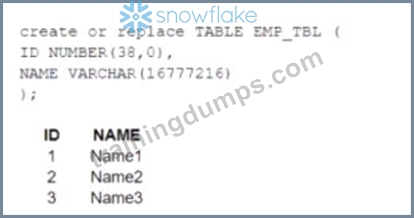
The following variables are set for the session:
Which SELECT statements will retrieve all three records? (Select TWO).
- A. SELECT * FROM $tb1_ref WHERE $col_ref IN ($var1, Svar2, Svar3);
- B. Select * FROM Stbl_ref WHERE Scol_ref IN ('Name1','Nam2','Name3');
- C. SELECT * FROM identifier($tbl_ref) WHERE ID IN Cvarl','var2','var3');
- D. SELECT * FROM EMP_TBL WHERE identifier(Scol_ref) IN ('Namel','Name2', 'Name3');
- E. SELECT * FROM identifier<Stbl_ref> WHERE NAME IN ($var1, $var2, $var3);
Answer: A,D
Explanation:
* The correct answer is B and E because they use the correct syntax and values for the identifier function and the session variables.
* The identifier function allows you to use a variable or expression as an identifier (such as a table name or column name) in a SQL statement. It takes a single argument and returns it as an identifier. For example, identifier($tbl_ref) returns EMP_TBL as an identifier.
* The session variables are set using the SET command and can be referenced using the $ sign. For example, $var1 returns Name1 as a value.
* Option A is incorrect because it uses Stbl_ref and Scol_ref, which are not valid session variables or identifiers. They should be $tbl_ref and $col_ref instead.
* Option C is incorrect because it uses identifier<Stbl_ref>, which is not a valid syntax for the identifier function. It should be identifier($tbl_ref) instead.
* Option D is incorrect because it uses Cvarl, var2, and var3, which are not valid session variables or values. They should be $var1, $var2, and $var3 instead. References:
* Snowflake Documentation: Identifier Function
* Snowflake Documentation: Session Variables
* Snowflake Learning: SnowPro Advanced: Architect Exam Study Guide
NEW QUESTION # 49
......
ARA-C01 Study Guide Brilliant ARA-C01 Exam Dumps PDF: https://pdfvce.trainingdumps.com/ARA-C01-valid-vce-dumps.html
