

Microsoft DP-600 Test Engine Dumps Training With 112 Questions
DP-600 Questions Pass on Your First Attempt Dumps for Microsoft Certified Certified
Microsoft DP-600 Exam Syllabus Topics:
| Topic | Details |
|---|---|
| Topic 1 |
|
| Topic 2 |
|
| Topic 3 |
|
| Topic 4 |
|
NEW QUESTION # 26
You have a Fabric tenant tha1 contains a takehouse named Lakehouse1. Lakehouse1 contains a Delta table named Customer.
When you query Customer, you discover that the query is slow to execute. You suspect that maintenance was NOT performed on the table.
You need to identify whether maintenance tasks were performed on Customer.
Solution: You run the following Spark SQL statement:
REFRESH TABLE customer
Does this meet the goal?
- A. Yes
- B. No
Answer: B
Explanation:
No, the REFRESH TABLE statement does not provide information on whether maintenance tasks were performed. It only updates the metadata of a table to reflect any changes on the data files. Reference = The use and effects of the REFRESH TABLE command are explained in the Spark SQL documentation.
NEW QUESTION # 27
You have a Fabric tenant that contains 30 CSV files in OneLake. The files are updated daily.
You create a Microsoft Power Bl semantic model named Modell that uses the CSV files as a data source. You configure incremental refresh for Model 1 and publish the model to a Premium capacity in the Fabric tenant.
When you initiate a refresh of Model1, the refresh fails after running out of resources.
What is a possible cause of the failure?
- A. The data type of the column used to partition the data has changed.
- B. Only refresh complete days is selected.
- C. Query folding is NOT occurring.
- D. XMLA Endpoint is set to Read Only.
- E. Query folding is occurring.
Answer: A
NEW QUESTION # 28
You are implementing two dimension tables named Customers and Products in a Fabric warehouse.
You need to use slowly changing dimension (SCO) to manage the versioning of data. The solution must meet the requirements shown in the following table.
Which type of SCD should you use for each table? To answer, drag the appropriate SCD types to the correct tables. Each SCD type may be used once, more than once, or not at all. You may need to drag the split bar between panes or scroll to view content.
NOTE: Each correct selection is worth one point.
Answer:
Explanation: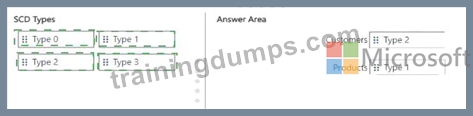
Explanation:
For the Customers table, where the requirement is to create a new version of the row, you would use:
* Type 2 SCD: This type allows for the creation of a new record each time a change occurs, preserving the history of changes over time.
For the Products table, where the requirement is to overwrite the existing value in the latest row, you would use:
* Type 1 SCD: This type updates the record directly, without preserving historical data.
NEW QUESTION # 29
You have a Fabric workspace named Workspace 1 that contains a dataflow named Dataflow1. Dataflow! has a query that returns 2.000 rows. You view the query in Power Query as shown in the following exhibit.
What can you identify about the pickupLongitude column?
- A. The column has duplicate values.
- B. There are 935 values that occur only once.
- C. The column has missing values.
- D. All the table rows are profiled.
Answer: A
Explanation:
The pickupLongitude column has duplicate values. This can be inferred because the 'Distinct count' is 935 while the 'Count' is 1000, indicating that there are repeated values within the column. References = Microsoft Power BI documentation on data profiling could provide further insights into understanding and interpreting column statistics like these.
NEW QUESTION # 30
You have a Fabric tenant that contains lakehouse named Lakehousel. Lakehousel contains a Delta table with eight columns. You receive new data that contains the same eight columns and two additional columns.
You create a Spark DataFrame and assign the DataFrame to a variable named df. The DataFrame contains the new data. You need to add the new data to the Delta table to meet the following requirements:
* Keep all the existing rows.
* Ensure that all the new data is added to the table.
How should you complete the code? To answer, select the appropriate options in the answer area.
Answer:
Explanation:
Explanation:
o add new data to the Delta table while meeting the specified requirements:
* You should use the append mode to ensure that all new data is added to the table without affecting the existing rows.
* You should set the mergeSchema option to true to allow the schema of the Delta table to be updated with the new columns found in the DataFrame.
The completed code would look like this:
df.write.format("delta").mode("append")
option("mergeSchema", "true")
saveAsTable("Lakehouse1.TableName")
NEW QUESTION # 31
You have a Fabric tenant that contains a warehouse.
You use a dataflow to load a new dataset from OneLake to the warehouse.
You need to add a Power Query step to identify the maximum values for the numeric columns.
Which function should you include in the step?
- A. Table.Profile
- B. Table.Range
- C. Table. MaxN
- D. Table.Max
Answer: D
NEW QUESTION # 32
You have a Fabric tenant.
You plan to create a Fabric notebook that will use Spark DataFrames to generate Microsoft Power Bl visuals.
You run the following code.
For each of the following statements, select Yes if the statement is true. Otherwise, select No. NOTE: Each correct selection is worth one point.
Answer:
Explanation: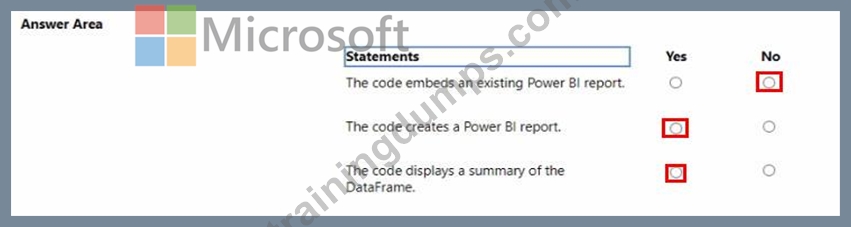
Reference:
Introduction to DataFrames - Spark SQL
Power BI and Azure Databricks
NEW QUESTION # 33
You have a Fabric tenant that contains a warehouse named Warehouse1. Warehouse1 contains three schemas named schemaA, schemaB. and schemaC You need to ensure that a user named User1 can truncate tables in schemaA only.
How should you complete the T-SQL statement? To answer, select the appropriate options in the answer area.
NOTE: Each correct selection is worth one point.
Answer:
Explanation:
Explanation:
* GRANT ALTER ON SCHEMA::schemaA TO User1;
The ALTER permission allows a user to modify the schema of an object, and granting ALTER on a schema will allow the user to perform operations like TRUNCATE TABLE on any object within that schema. It is the correct permission to grant to User1 for truncating tables in schemaA.
References =
* GRANT Schema Permissions
* Permissions That Can Be Granted on a Schema
NEW QUESTION # 34
You have the source data model shown in the following exhibit.
The primary keys of the tables are indicated by a key symbol beside the columns involved in each key.
You need to create a dimensional data model that will enable the analysis of order items by date, product, and customer.
What should you include in the solution? To answer, select the appropriate options in the answer area.
NOTE: Each correct selection is worth one point.
Answer:
Explanation:
Explanation:
* The relationship between OrderItem and Product must be based on: Both the CompanyID and the ProductID columns
* The Company entity must be: Denormalized into the Customer and Product entities In a dimensional model, the relationships are typically based on foreign key constraints between the fact table (OrderItem) and dimension tables (Product, Customer, Date). Since CompanyID is present in both the OrderItem and Product tables, it acts as a foreign key in the relationship. Similarly, ProductID is a foreign key that relates these two tables. To enable analysis by date, product, and customer, the Company entity would need to be denormalized into the Customer and Product entities to ensure that the relevant company information is available within those dimensions for querying and reporting purposes.
References =
* Dimensional modeling
* Star schema design
NEW QUESTION # 35
You have a Fabric tenant that contains 30 CSV files in OneLake. The files are updated daily.
You create a Microsoft Power Bl semantic model named Modell that uses the CSV files as a data source. You configure incremental refresh for Model 1 and publish the model to a Premium capacity in the Fabric tenant.
When you initiate a refresh of Model1, the refresh fails after running out of resources.
What is a possible cause of the failure?
- A. Only refresh complete days is selected.
- B. Query folding is NOT occurring.
- C. XMLA Endpoint is set to Read Only.
- D. Query folding is occurring.
- E. The data type of the column used to partition the data has changed.
Answer: B
Explanation:
A possible cause for the failure is that query folding is NOT occurring (D). Query folding helps optimize refresh by pushing down the query logic to the source system, reducing the amount of data processed and transferred, hence conserving resources. Reference = The Power BI documentation on incremental refresh and query folding provides detailed information on this topic.
NEW QUESTION # 36
You have an Amazon Web Services (AWS) subscription that contains an Amazon Simple Storage Service (Amazon S3) bucket named bucketl.
You have a Fabric tenant that contains a lakehouse named LH1.
In LH1, you plan to create a OneLake shortcut to bucketl.
You need to configure authentication for the connection.
Which two values should you provide? Each correct answer presents part of the solution.
NOTE: Each correct selection is worth one point.
- A. the access ID
- B. the shared access signature (SAS) token
- C. the access key ID
- D. the secret access key
- E. the certificate thumbprint
Answer: C,D
NEW QUESTION # 37
You are creating a dataflow in Fabric to ingest data from an Azure SQL database by using a T-SQL statement.
You need to ensure that any foldable Power Query transformation steps are processed by the Microsoft SQL Server engine.
How should you complete the code? To answer, drag the appropriate values to the correct targets. Each value may be used once, more than once, or not at all. You may need to drag the split bar between panes or scroll to view content.
NOTE: Each correct selection is worth one point.
Answer:
Explanation:
NEW QUESTION # 38
Note: This question is part of a series of questions that present the same scenario. Each question in the series contains a unique solution that might meet the stated goals. Some question sets might have more than one correct solution, while others might not have a correct solution.
After you answer a question in this section, you will NOT be able to return to it. As a result, these questions will not appear in the review screen.
You have a Fabric tenant that contains a semantic model named Model1.
You discover that the following query performs slowly against Model1.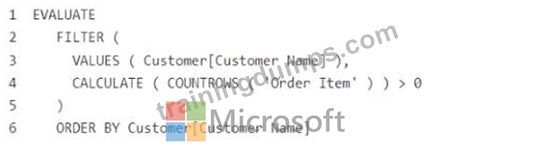
You need to reduce the execution time of the query.
Solution: You replace line 4 by using the following code:
Does this meet the goal?
- A. No
- B. Yes
Answer: B
NEW QUESTION # 39
You have a Microsoft Power B1 report and a semantic model that uses Direct Lake mode. From Power Si Desktop, you open Performance analyzer as shown in the following exhibit.
Use the drop-down menus to select the answer choice that completes each statement based on the information presented in the graphic. NOTE: Each correct selection is worth one point.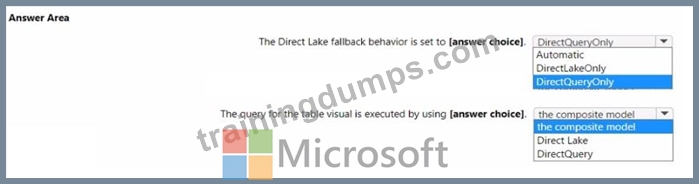
Answer:
Explanation:
NEW QUESTION # 40
You have a Fabric tenant that contains a lakehouse named Lakehouse1.
You need to prevent new tables added to Lakehouse1 from being added automatically to the default semantic model of the lakehouse.
What should you configure? (5)
- A. the Lakehouse1 settings
- B. the SQL analytics endpoint settings
- C. the workspace settings
- D. the semantic model settings
Answer: B
Explanation:
To prevent new tables added to Lakehouse1 from being automatically added to the default semantic model, you should configure the semantic model settings. There should be an option within the settings of the semantic model to include or exclude new tables by default. By adjusting these settings, you can control the automatic inclusion of new tables.
NEW QUESTION # 41
You have a Fabric workspace named Workspace1 that contains a data flow named Dataflow1. Dataflow1 contains a query that returns the data shown in the following exhibit.
You need to transform the date columns into attribute-value pairs, where columns become rows.
You select the VendorlD column.
Which transformation should you select from the context menu of the VendorlD column?
- A. Group by
- B. Remove other columns
- C. Unpivot other columns
- D. Split column
- E. Unpivot columns
Answer: E
Explanation:
The transformation you should select from the context menu of the VendorID column to transform the date columns into attribute-value pairs, where columns become rows, is Unpivot columns (B). This transformation will turn the selected columns into rows with two new columns, one for the attribute (the original column names) and one for the value (the data from the cells). References = Techniques for unpivoting columns are covered in the Power Query documentation, which explains how to use the transformation in data modeling.
NEW QUESTION # 42
You have a Fabric tenant that contains a lakehouse named Lakehouse1.
You need to prevent new tables added to Lakehouse1 from being added automatically to the default semantic model of the lakehouse.
What should you configure? (5)
- A. the Lakehouse1 settings
- B. the SQL analytics endpoint settings
- C. the workspace settings
- D. the semantic model settings
Answer: B
Explanation:
To prevent new tables added to Lakehouse1 from being automatically added to the default semantic model, you should configure the semantic model settings. There should be an option within the settings of the semantic model to include or exclude new tables by default. By adjusting these settings, you can control the automatic inclusion of new tables.
References: The management of semantic models and their settings would be covered under the documentation for the semantic layer or modeling features of the Fabric tenant's lakehouse solution.
NEW QUESTION # 43
You have a Fabric workspace named Workspace1 and an Azure Data Lake Storage Gen2 account named storage"!. Workspace1 contains a lakehouse named Lakehouse1.
You need to create a shortcut to storage! in Lakehouse1.
Which connection and endpoint should you specify? To answer, select the appropriate options in the answer area.
NOTE: Each correct selection is worth one point.
Answer:
Explanation:
Explanation:
When creating a shortcut to an Azure Data Lake Storage Gen2 account in a lakehouse, you should use the abfss (Azure Blob File System Secure) connection string and the dfs (Data Lake File System) endpoint. The abfss is used for secure access to Azure Data Lake Storage, and the dfs endpoint indicates that the Data Lake Storage Gen2 capabilities are to be used.
NEW QUESTION # 44
You have a Fabric tenant.
You are creating a Fabric Data Factory pipeline.
You have a stored procedure that returns the number of active customers and their average sales for the current month.
You need to add an activity that will execute the stored procedure in a warehouse. The returned values must be available to the downstream activities of the pipeline.
Which type of activity should you add?
- A. Stored procedure
- B. Get metadata
- C. Lookup
- D. Copy data
Answer: C
Explanation:
In a Fabric Data Factory pipeline, to execute a stored procedure and make the returned values available for downstream activities, the Lookup activity is used. This activity can retrieve a dataset from a data store and pass it on for further processing. Here's how you would use the Lookup activity in this context:
* Add a Lookup activity to your pipeline.
* Configure the Lookup activity to use the stored procedure by providing the necessary SQL statement or stored procedure name.
* In the settings, specify that the activity should use the stored procedure mode.
* Once the stored procedure executes, the Lookup activity will capture the results and make them available in the pipeline's memory.
* Downstream activities can then reference the output of the Lookup activity.
References: The functionality and use of Lookup activity within Azure Data Factory is documented in Microsoft's official documentation for Azure Data Factory, under the section for pipeline activities.
NEW QUESTION # 45
You have a Fabric tenant that contains a warehouse named Warehouse1. Warehouse1 contains three schemas named schemaA, schemaB. and schemaC You need to ensure that a user named User1 can truncate tables in schemaA only.
How should you complete the T-SQL statement? To answer, select the appropriate options in the answer area.
NOTE: Each correct selection is worth one point.
Answer:
Explanation:
Explanation:
* GRANT ALTER ON SCHEMA::schemaA TO User1;
The ALTER permission allows a user to modify the schema of an object, and granting ALTER on a schema will allow the user to perform operations like TRUNCATE TABLE on any object within that schema. It is the correct permission to grant to User1 for truncating tables in schemaA.
References =
* GRANT Schema Permissions
* Permissions That Can Be Granted on a Schema
NEW QUESTION # 46
......
DP-600 Practice Test Pdf Exam Material: https://pdfvce.trainingdumps.com/DP-600-valid-vce-dumps.html
